
Criminal Court Records in Kiowa County
A Kiowa County criminal court record is the full case file the Court Clerk opens the moment the state files a charge. It is not a single page. It is a running Kiowa County file that grows with every document, hearing, and ruling until the case closes. The Kiowa County Court Clerk, Aimee Vance, keeps these district court case files at the courthouse in Hobart. The file starts with the charging document and follows the Kiowa County case to the judge's final sentence. Booking paperwork from the jail is a separate record, and the filed accusations are tracked in the Kiowa County court charge records.
Most Kiowa County criminal cases are filed in the Kiowa County District Court, the general trial court for the county. Felony cases carry the prefix CF, and misdemeanors carry CM. The Kiowa County district court handles both. A second court, the Hobart Municipal Court, hears only city ordinance violations and municipal citations, so its files sit apart from the district court criminal record. Cases that cross into federal law leave the Kiowa County system entirely. For everyday felony and misdemeanor matters, the Kiowa County District Court file is the record that counts.
How to Search Kiowa County Criminal Court Records
Kiowa County does not run its own case-search website. Kiowa County criminal court records are searched through two statewide systems, the Oklahoma State Courts Network and On Demand Court Records. Both list Kiowa County District Court and let the public search Kiowa County cases for free. OSCN works best when you already have a Kiowa County case number. ODCR is the practical route for name searches across Kiowa County and other Oklahoma counties.
- Open the OSCN docket search and pick Kiowa County District Court from the court list, or open ODCR and set the court to Kiowa.
- Search by the defendant's name, or enter a known Kiowa County case number such as a CF or CM number.
- Narrow the results by case type and filing date to find the right Kiowa County criminal case.
- Open the Kiowa County case to read the docket entries, charges, plea, and disposition.
- Call or visit the Kiowa County Court Clerk at 580-726-5125 to request a certified copy or to view files that are not online.
OSCN posts only what the Kiowa County clerk has entered, and Oklahoma Court of Criminal Appeals Rule 2.6 warns that the online docket is a public convenience, not the official record. If the online file and the Kiowa County courthouse file differ, the court relies on its own case-management system. Scanned Kiowa County filings on ODCR may require a paid subscription limited to bar members. For the certified, complete file, the Kiowa County Court Clerk is the source.
Stages of a Kiowa County Criminal Case
A Kiowa County criminal case moves through fixed stages, and each stage leaves its own marks in the Kiowa County court record. Reading the Kiowa County file in order shows where a case stands and how it ended. The path runs from the first charge to the last order the judge signs.
Case flow: Charges Filed › Arraignment › Pretrial / Preliminary Hearing › Plea or Trial › Disposition › Sentencing
- Charges Filed: The Kiowa County district attorney files a complaint or information that lists the offenses and the statutes the state says were broken.
- Arraignment: The defendant first appears, hears the charges, learns the bond, and the court sets the next dates.
- Pretrial and Preliminary Hearing: In felony cases the court holds a preliminary hearing to test probable cause, and motions and bond reviews are filed and ruled on.
- Plea or Trial: The case ends in a plea, such as guilty or nolo contendere, or it goes to trial before a judge or jury.
- Disposition: The Kiowa County record logs the outcome of each charge, whether convicted, dismissed, or acquitted.
- Sentencing: The judge orders the sentence, which may add jail or prison time, fines, court costs, restitution, probation, or a deferred or suspended term.
Not every case touches every stage. Many Kiowa County misdemeanor cases skip the preliminary hearing and resolve with an early plea. A Kiowa County felony that goes to trial leaves the most detailed record.
What a Kiowa County Criminal Court Record Shows
Open a Kiowa County criminal court record and the case detail lays out structured fields. The same fields appear across OSCN and ODCR, drawn from what the Kiowa County Court Clerk enters. Together they tell who was charged, with what, and how the case ended. Sample Kiowa County felony cases show all of these parts in the public view.
| Field | What It Shows |
|---|---|
| Case Number | The county code, case prefix such as CF or CM, filing year, and sequence number that identify the file. |
| Defendant | The person charged, listed in the caption as State of Oklahoma versus the named party. |
| Filing Date | The date the district attorney filed charges and the clerk opened the case. |
| Charges | Each offense or cause, with the statute cited and the level marked as felony or misdemeanor. |
| Plea | The defendant's formal answer to each count, such as guilty, not guilty, or nolo contendere. |
| Disposition | The outcome of each charge, including conviction, dismissal, or acquittal. |
| Sentence | Any jail or prison term, fines, court costs, restitution, probation, or deferred or suspended terms. |
| Financial Balance | Amounts owed and any link to pay fees and costs online. |
| Docket Entries | The dated list of every filing, hearing, order, bond setting, and warrant in the case. |
The docket entries are the heart of the Kiowa County file. They show motions, hearing settings, and later Kiowa County filings such as an application to revoke or accelerate a sentence. A balance and a payment link often sit near the top of a Kiowa County case detail.
Charges vs. Convictions
A charge and a conviction are not the same thing, and a Kiowa County criminal court record can show both, or only one. A charge is what the state accuses in a Kiowa County case. A conviction is a court finding of guilt. Many Kiowa County cases list charges that were later dropped, dismissed, reduced, or that ended in acquittal.
| Charge | Conviction | |
|---|---|---|
| Stage | Accusation at filing | Verdict or accepted plea |
| Burden of Proof | Probable cause | Beyond a reasonable doubt |
| Who Decides | District attorney files | Judge or jury |
| Effect on Record | Appears as a filed charge | Appears as adjudicated guilt |
| Public Record | Yes | Yes |
Reading only the charge can mislead. Always check the disposition before drawing a conclusion about a Kiowa County criminal case.
Reading Kiowa County Criminal Dispositions
Disposition is the legal word for outcome in a Kiowa County case. In a Kiowa County criminal court record, each charge carries its own disposition tag. Sample Kiowa County felony cases show short codes in the offense and cause lines, such as a guilty plea or a nolo contendere plea. Learning the common terms makes the Kiowa County file readable.
- Disposition
- The final outcome of a charge or a case.
- Nolo contendere
- A no-contest plea that accepts punishment without admitting guilt.
- Deferred sentence
- Sentencing is delayed and may be dismissed if the defendant meets set conditions.
- Suspended sentence
- A custody term that is not served as long as conditions are followed.
- Acceleration
- A request to impose a deferred sentence after an alleged violation.
- Revocation
- A request to revoke a suspended sentence and impose the custody term.
A sentence in a Kiowa County record may combine several parts. A judge can order jail or prison time, a fine, court costs, restitution to victims, and a term of probation. Watch for later Kiowa County filings too. An application to revoke or accelerate can reopen a Kiowa County case long after the first sentence, and a bench warrant entry can flag a missed payment or court date.
Sealed vs. Expunged Records
Some Kiowa County criminal records are removed from public view by court order. Oklahoma uses two related tools, sealing and expungement, and they are not identical for a Kiowa County record. Both require a petition and a judge's signed order, and both depend on the charge, the outcome, and whether the Kiowa County defendant met every condition.
| Sealed | Expunged | |
|---|---|---|
| Visibility | Hidden from public search | Treated as though it never existed |
| Law Enforcement | Limited access remains | Very limited access |
| Governing Law | 22 O.S. 19 procedure | 22 O.S. 18 eligibility |
| Eligibility | Set by the sealing statute and the order | Set by charge, outcome, and waiting period |
Oklahoma sets out who qualifies to clear a Kiowa County record in its expungement statute, 22 O.S. 18.
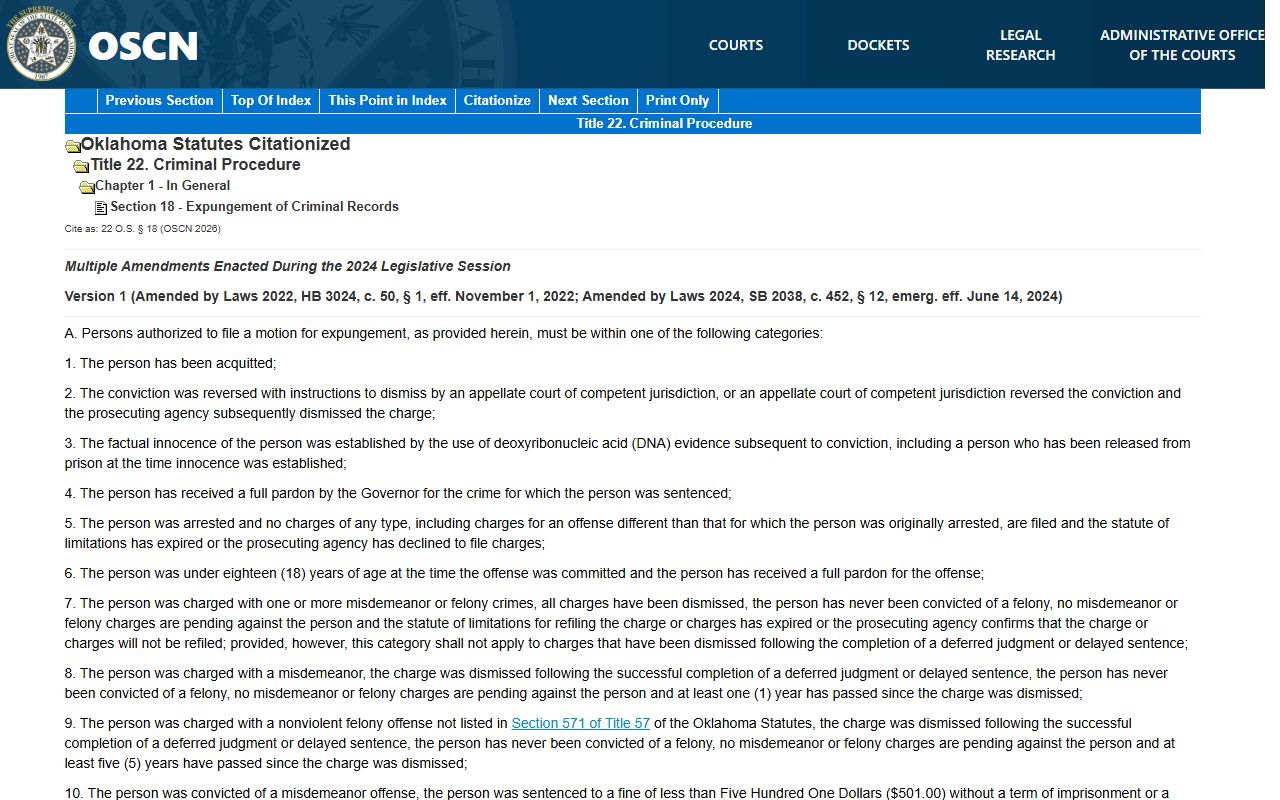
The statute lists categories such as dismissed cases, acquittals, and convictions that have aged past a waiting period. A Kiowa County petitioner must fit one of them before a court will expunge a criminal record.
Prosecution and Defense in Kiowa County Cases
Two offices drive most Kiowa County criminal cases. The district attorney files and prosecutes the Kiowa County charges. When a Kiowa County defendant cannot afford a lawyer, court-appointed counsel comes through the state indigent defense system. Both leave their names on the Kiowa County case record.
Kiowa County sits in Oklahoma District Attorney District 3, led by District Attorney Dan Jacobsma. The district covers Greer, Harmon, Jackson, Kiowa, and Tillman counties. Assistant District Attorney Jordan Cabelka handles Kiowa County matters from the local office, which also processes payments for restitution, supervision, and program fees.
Kiowa County District Attorney (District 3)
316 S. Main
Hobart, OK 73651
580-726-3335
Indigent defense in Kiowa County runs through the Oklahoma Indigent Defense System non-capital trial office in Altus, which covers Jackson, Tillman, Kiowa, Greer, and Harmon counties.
OIDS Non-Capital Trial Office, Altus
123 W. Commerce St, Suite 100
Altus, OK 73521
580-782-2429
Public Access to Kiowa County Criminal Records
Kiowa County criminal court records are public under Oklahoma law. The Oklahoma Open Records Act treats Kiowa County court and law-enforcement records as open unless a statute makes them confidential. That is why anyone can search a Kiowa County felony or misdemeanor case on OSCN or ODCR without showing a reason. Broader case types beyond criminal matters appear in the Kiowa County court records.
Key Statutes:
Oklahoma Statutes § 51-24A.5 - public records are open for inspection and copying during regular business hours.
Oklahoma Statutes § 51-24A.8 - law-enforcement agencies must keep certain booking and arrest information public.
Court of Criminal Appeals Rule 2.6 - the online OSCN docket is a public convenience and does not replace the official court file.
Custody Status After Sentencing
The Kiowa County court record ends at sentencing, but two state tools pick up what happens next. Once a Kiowa County defendant is sentenced to prison and transferred, the Oklahoma Department of Corrections tracks the offender. For custody alerts, Oklahoma VINE sends free notifications about Kiowa County court events and release.
- The Oklahoma DOC offender lookup shows sentenced state prisoners, though DOC warns the data is abbreviated and not a full account of a Kiowa County sentence.
- Oklahoma VINE provides 24-hour custody-status and court-event notifications and is free and confidential.
- Local jail custody before sentencing is confirmed by calling the Kiowa County Sheriff's Office at 580-726-3265.
Note: DOC lists only sentenced state offenders, so a recent Kiowa County booking may not appear there until the case reaches a prison sentence.
Background Check Considerations
A casual Kiowa County criminal record lookup is not a legal background check. Searching OSCN or ODCR tells you what a Kiowa County case shows, but employers, landlords, and licensing boards that make decisions must follow the federal Fair Credit Reporting Act. That law requires a regulated consumer reporting agency, written notice, and the subject's consent before a covered report is used.
Important: This site is not a consumer reporting agency under the FCRA, and its records cannot be used for employment, tenant, credit, or insurance decisions.
Restricted Kiowa County Criminal Records
Not every Kiowa County criminal court record is open. Some Kiowa County files are closed by law, and others are closed by a judge. Juvenile delinquency and deprived cases in Kiowa County are restricted and are not ordinary public dockets. Sealed and expunged Kiowa County cases drop out of public search. Active investigative files, victim addresses, Social Security numbers, and similar personal details may be redacted or withheld.
Oklahoma sets the steps for closing a Kiowa County record in its sealing statute, 22 O.S. 19.
The procedure controls how a Kiowa County record is sealed and later unsealed. A portal that stops showing a case is not proof of sealing, because agencies may still hold copies until the order reaches them. The controlling document is the judge's signed order, and the holding office, usually the Court Clerk, applies it.