
Kiowa County Arrest Records and Court Charges
An arrest record is the law enforcement account of an arrest. It names the arresting agency, the date, and the booking that places a person into the jail system. In Kiowa County, arrests are commonly made by the Kiowa County Sheriff's Office or a city police department such as Hobart's. The arrest by itself does not set the charges. After the arrest, the district attorney reviews the reports and decides what to file. Those filed accusations are the court charges, and the Kiowa County Court Clerk enters them into the case record. This is why a booking charge can read differently from the charge that finally appears in court.
Two records grow from a single arrest. The booking side stays with the sheriff and shows custody status, bond, and release. For the jail roster and booking detail, the Kiowa County inmate records page is the right starting point. The court charge record is what the prosecutor filed, and it is tracked through the case from the first appearance to the final order. The court charges after arrest, along with the pleas and the sentence, sit inside the full case file. For that complete file, the Kiowa County criminal court records page follows a case from charge to disposition.
How to Find Kiowa County Arrest Records and Charges
Charges and charge status appear in the public court case search, not in a separate arrest database. Kiowa County feeds its District Court cases into two statewide systems. The Oklahoma State Courts Network, known as OSCN, carries case dockets and a case-number lookup. On Demand Court Records, known as ODCR, lists Kiowa among its counties and is the practical route for a name search. Booking and custody detail, by contrast, stays with the sheriff and on the jail roster.
- Open OSCN or ODCR and choose the court case search tool, then set the court to Kiowa County District Court.
- Search by the defendant's name, or enter a known Kiowa County case number such as a CF or CM file.
- Open the case and read the offense or cause lines that list each charge filed after the arrest.
- Check every charge for its statute code, severity level, and current status before drawing any conclusion.
Charges that end in a state prison sentence roll up into statewide tools run by the Oklahoma Department of Corrections. The Oklahoma DOC offender lookup finds people sentenced into state custody and shows abbreviated charge and sentence information.
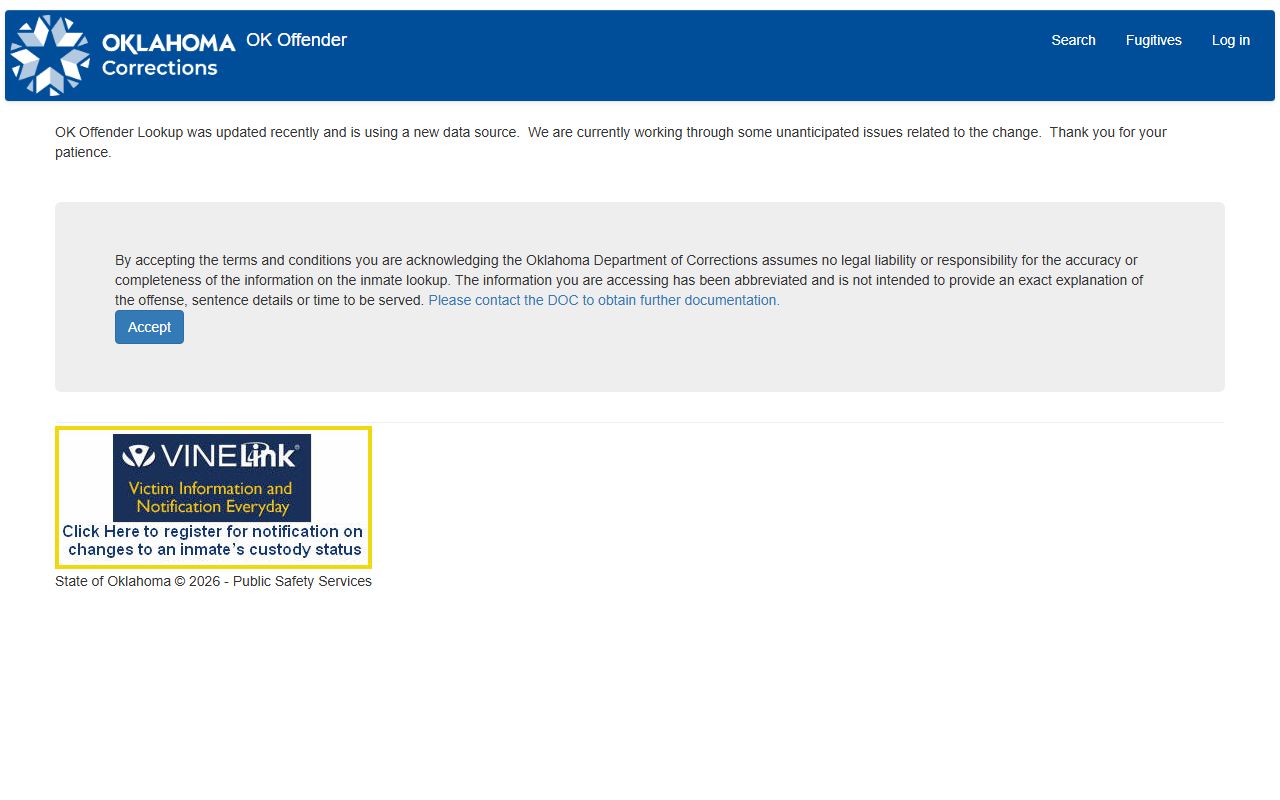
That lookup helps when a Kiowa County charge has already reached a conviction and a prison term, though it does not replace the live court docket for charges that are still pending.
How Charges Get Filed After an Arrest: Complaint, Information, and Indictment
The court charge record begins when the prosecutor files a charging document. In Oklahoma, most felony and misdemeanor cases in Kiowa County District Court open with an Information, which is the district attorney's formal written accusation. A complaint is the early sworn accusation, often used at the start of a misdemeanor. An indictment comes from a grand jury and is reserved for the most serious felonies. Each one starts a Kiowa County case and lists the offenses by statute. The three documents differ mainly in who files them and the kind of charge they carry.
| Complaint | Information | Indictment | |
|---|---|---|---|
| Filed By | Officer / Prosecutor | Prosecutor | Grand Jury |
| Common For | Misdemeanors | Many felonies | Serious felonies |
| Starts | The case | The case | The case |
Once charges are filed, a defendant who cannot afford a lawyer is assigned counsel through the state program shown on the Oklahoma Indigent Defense System Kiowa coverage page.
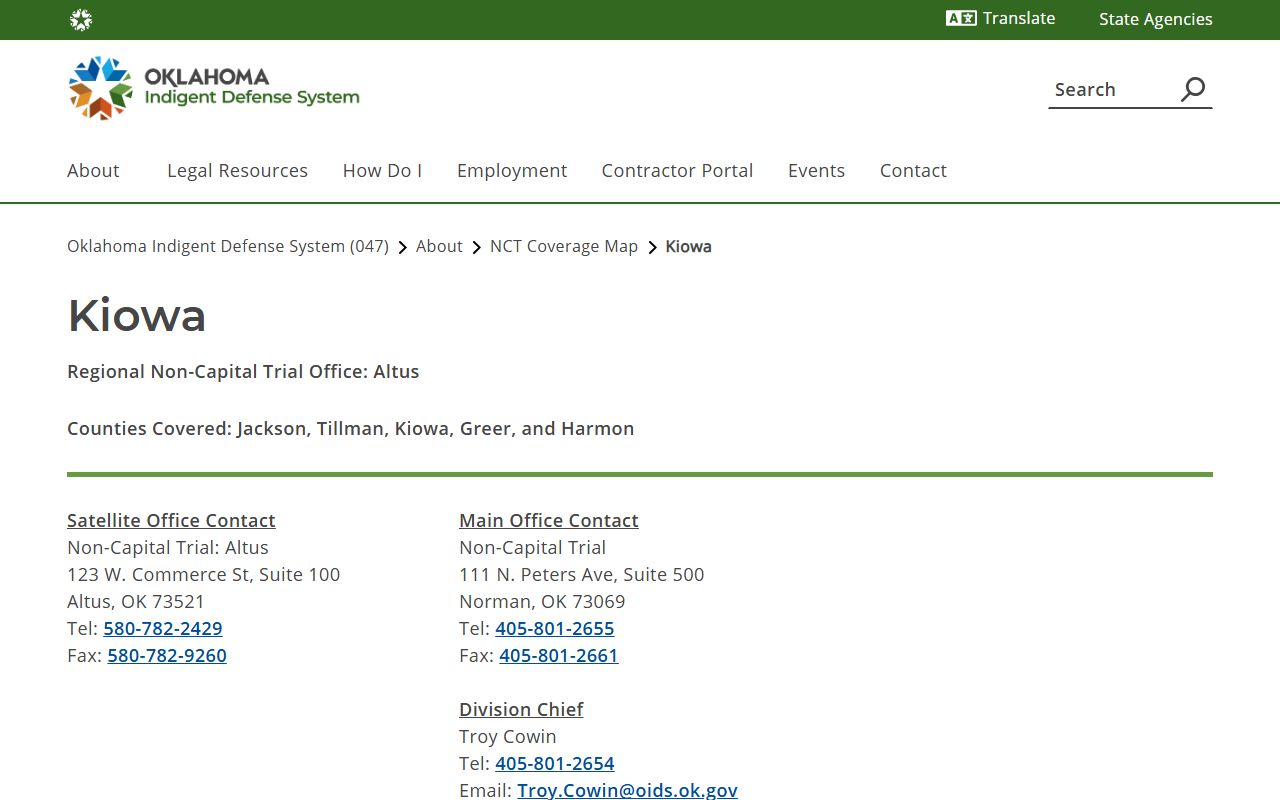
Kiowa County falls under the OIDS regional trial office in Altus, so the charges a prosecutor files are answered by an assigned defense team when the defendant qualifies. Charges in Kiowa County are filed by the District Attorney for District 3. That district covers Greer, Harmon, Jackson, Kiowa, and Tillman Counties, and Dan Jacobsma serves as the district attorney. The Kiowa County office sits inside the courthouse on South Main in Hobart, where Assistant District Attorney Jordan Cabelka handles local matters. The prosecutor can file fewer charges than the arrest suggested, add more, or file none at all. That discretion is one more reason a booking charge and a filed court charge may not match.
Charge Status and What It Means
Charges do not stay frozen. As a Kiowa County case moves, the prosecutor can amend a charge, reduce it, add a count, or drop it, and a judge can dismiss it. The public docket records each change with a date, so the current status may differ from the charge first filed after the arrest. Reading the latest entry matters far more than reading the first.
| Status | What It Means |
|---|---|
| Pending | The charge is filed and the case is still open, with no final ruling yet. |
| Amended / Reduced | The prosecutor changed the charge, often to a lower level or a different offense. |
| Dismissed | A judge ended the charge; it may be with prejudice (cannot be refiled) or without. |
| Nolle Prosequi | The prosecutor chose not to pursue the charge and dropped it from the case. |
Note: A dropped or dismissed charge can still show in the docket history, because the entry records what happened rather than erasing it.
Charges vs. Convictions
Being charged is not the same as being convicted. A charge is the accusation a prosecutor files, and it rests on probable cause. A conviction is a finding of guilt, reached by a plea or a verdict in a Kiowa County court and held to a much higher standard. Many Kiowa County charges end without a conviction through dismissal, acquittal, or a deferred outcome. Treating a filed charge as proof of guilt is a common and serious mistake. The disposition line tells the real story, and sample Kiowa County cases show outcomes such as a guilty plea or a no-contest plea.
| Charge | Conviction | |
|---|---|---|
| Stage | Accusation | Verdict or plea |
| Burden of Proof | Probable cause | Beyond reasonable doubt |
| Public Record | Yes | Yes |
Sealed vs. Expunged Records
Some charges leave the public view. Oklahoma law lets qualifying records be sealed or expunged by court order under Title 22, Sections 18 and 19. A sealed record is hidden from ordinary public searches but still exists. An expunged record is treated as though it never happened for most purposes. Eligibility in a Kiowa County case depends on the charge, the outcome, any waiting period, and whether all costs and sentence terms are satisfied.
| Sealed | Expunged | |
|---|---|---|
| Visibility | Hidden from public | Destroyed / treated as never existed |
| Law Enforcement | Limited access | Very limited |
| Eligibility | Set by 22 O.S. 19 once conditions are met | Set by 22 O.S. 18 by charge type and outcome |
Charge Codes and Severity Levels
Every charge ties back to a statute, and that statute fixes the severity level. In Oklahoma, the main split is between a felony and a misdemeanor, with lesser violations handled as infractions or city ordinance offenses. Kiowa County case prefixes reflect the split directly. A single Kiowa County arrest can produce several separate charges, each with its own code, level, and status. The offense or cause line in a Kiowa County case lists the statute language for each count, so one case page can show multiple charges at different severity levels.
Common Kiowa County District Court charge prefixes include:
- CF: a criminal felony charge.
- CM: a criminal misdemeanor charge.
- TR: a state-law traffic citation filed in District Court.
- CJ: a civil case rather than a criminal charge.
City ordinance citations follow a separate path. A Hobart municipal traffic or ordinance charge is handled by the Hobart Municipal Court, not the District Court, so it carries its own citation format and does not appear under a Kiowa County District Court prefix.
Statewide Charge and Criminal History Lookups
Charges that lead to a state prison sentence become part of the Oklahoma Department of Corrections records. The DOC runs a public offender lookup, a separate violent offender search, and the state sex offender registry. These are statewide tools, so they reach well beyond Kiowa County and cover anyone sentenced into state custody. They show abbreviated data, and the DOC warns that a listing is not a full account of a sentence.
The Oklahoma DOC homepage gathers the offender lookup, the registries, and open-records request links in one place.
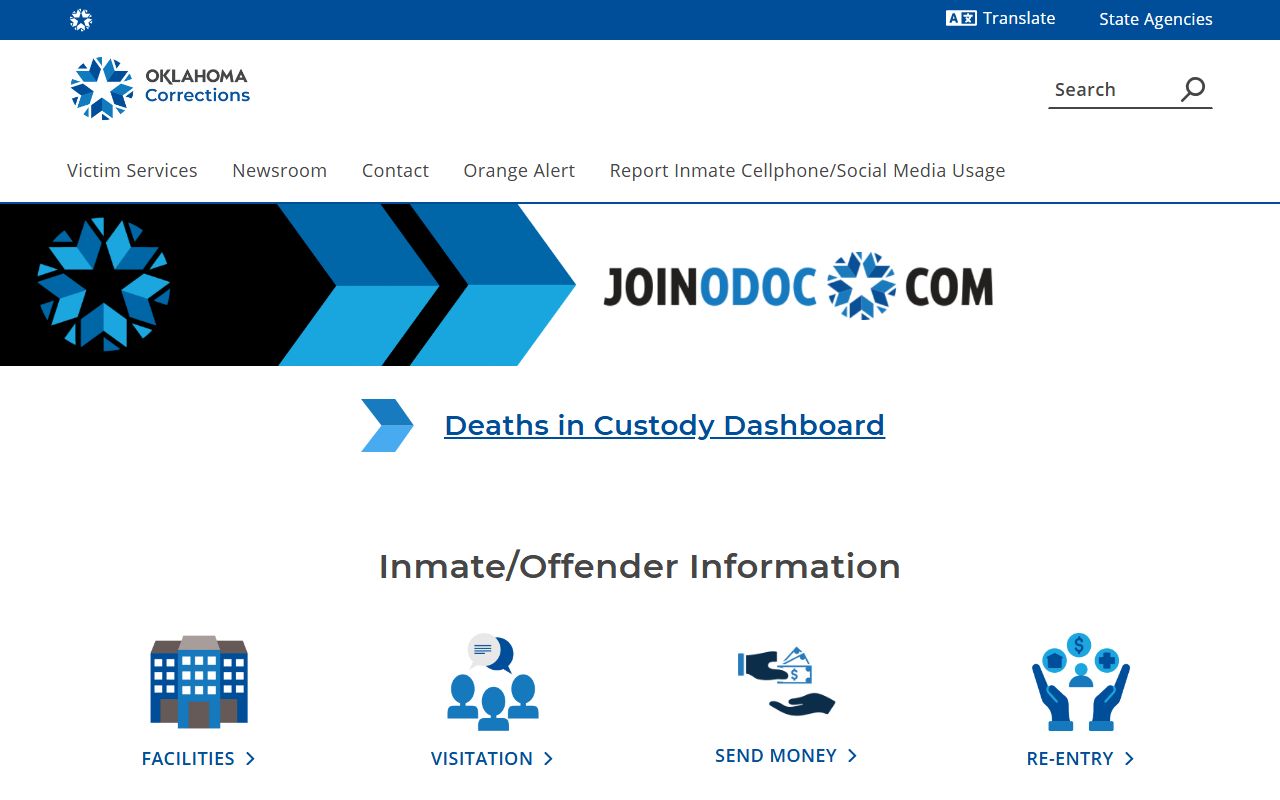
From there a Kiowa County reader can move from a local charge to the statewide record once a conviction sends a person to prison. For sex offense convictions, the Oklahoma sex offender registry lists registered offenders across the state. None of these tools replace the live Kiowa County District Court docket, which stays the place to track a charge while a case is open.
Background Check Considerations
A formal background check is different from a quick Kiowa County docket search. Employers, landlords, and licensing bodies use background checks governed by the federal Fair Credit Reporting Act, which sets accuracy and dispute rules. A casual look at a Kiowa County charge on a court portal carries none of those protections. For any decision that affects a person's job, housing, or credit, a regulated screening service is the correct route, and the raw court docket is not.
Important: This site is not a consumer reporting agency under the Fair Credit Reporting Act, and its information cannot be used for employment, housing, credit, or other FCRA-regulated decisions.
Restricted Charge Records in Kiowa County
Not every Kiowa County charge is open to the public. Juvenile charges are kept out of the ordinary public dockets. Sealed and expunged charges are suppressed by court order. Some systems withhold dismissed charges, and active investigations stay protected while they are open. The Oklahoma Open Records Act, at Title 51, Section 24A, sets the general rule of access, while Section 24A.8 governs law-enforcement and jail-register records.
When a charge does not appear online, the record may simply be older, restricted, or not yet entered. The Kiowa County Court Clerk can confirm a court charge and provide certified copies, and the Kiowa County Sheriff's Office answers booking and jail-register questions. Either office can explain how to file an Open Records Act request for a non-confidential record that is not posted online.
Note: A charge missing from an online search is not proof the record was cleared, since sealing and expungement happen only by a signed court order.